Table of Contents
Cheyenne Mountain Complex
The Cheyenne Mountain Complex (CMC) was built in the early 1960s by the Army Corps of Engineers, Utah Construction and Mining Company, and Burroughs among other contracts. Besides serving as the secret location of the Stargate, the CMC was an alternate command center of the Northern Air Defense Command (NORAD), the Space Defense Center, the National Civil Defense Warning Center, Ballistic Missile Defense Center, and other Strategic Air Command-related functions starting from its formal commissioning in 1967.
As a result of improving technology (e.g. the Joint Surveillance System radar network and its multiple command centers) and changing threats (the transition from bombers to ballistic missiles), the military value of CMC declined starting in the 1970s, and functions slowly moved away. Although CMC is no longer a key military control center, it continues to receive some degree of maintenance and modernization as a secondary command center and training site for NORAD and USNORTHCOM.
operating instructions
Various functions are available as part of the map.
mouse/touch operation
- moving by grabbing the map with a mouse-click you can move the map around
- overview map using the < button in the bottom right of the map you can expand an overview map
- zooming in and out using the + and - buttons in the top left of the map you can obtain more or less detail in the map
- switching themes or maps clicking on the ≡ icon on the right-hand side of the map you can view and select available maps and themes
- retrieving information the map may contain elements that contain more information, by clicking these a popup will show this information
- fullscreen display using the ⛶ button the map can be maximized to fullscreen display, use the ▢ button to return to page display.
keyboard operation
Keyboard operation becomes available after activating the map using the tab key (the map will show a focus indicator ring).
- moving using the arrow keys you can move the map
- overview map using the + button in the bottom right of the map you can expand an overview map
- zooming in and out using the + and - buttons in the top left of the map or by using the + and - keys you can obtain more or less detail in the map
- switching themes or maps clicking on the ≡ icon on the right-hand side of the map you can view and select available maps and themes
- retrieving information the map may contain elements that contain more information, using the i key you can activate a cursor that may be moved using the arrow keys, pressing the enter will execute an information retrieval. press the i or the escape key to return to navigation mode
- fullscreen display using the ⛶ button the map can be maximized to fullscreen display, use the ▢ button to return to page display.
It's possible that some of the functions or buttons describe above have been disabled by the page author or the administrator
| id | symbol | latitude | longitude | description |
|---|---|---|---|---|
 |
 |
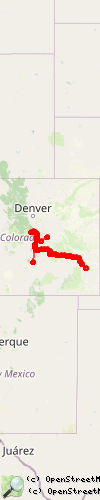
KML track: map | ||
(You can download this KML file)
Routes
Because of CMC's importance as a military control center, and its hardened design, it had multiple redundant connections to AUTOVON and the general telephone network. These included microwave hops directly from north and south microwave sites, and two L-1 coaxial cables.
| Destination | Direction | Carrier |
|---|---|---|
| Boone | Southeast | L-1 |
| Westcreek | Northwest | L-1 |
| Calhan CO | TD-2? | |
| Beulah CO | TD-2? | |
| Corral Bluffs CO | TD-2 |
"Ring" Network
A 1965 BLR article describes CMC as surrounded by a ring of microwave sites for redundancy, called the “Close-in Automatic Route Restoral System.” It's surprisingly difficult to match up this “ring” with known sites, perhaps beacuse of changes over the years. CMC is depicted in the article as having four coaxial cables and two microwave paths linking it to this ring. We know the two microwave paths (to Beulah and Calhan) and two of the coaxial cable (to Boone and Westcreek), but two of the cables remain unidentified. They head west from the site, rather than east like the other connections, at least if the simplified map is to be trusted.
That said, the article says “eventually” and describes only two of the spokes as operational. That suggests that the two unexplained spokes may have simply never been constructed. Similarly, the outer “ring” routes may not have been completed, since the existing microwave sites do not quite form a ring.
It is an interesting detail that CARRS is described as supporting 600 message channels and a two-way monochrome video channel.
Coaxial
It's probably fair to say that CMC's “primary” telephone connection was the L-1 cable to the Lamar, CO L-3I main station via Boone. The entire route of this cable can be traced via the repeater huts at 8 mile intervals. From the CMC, the L-1 cable runs generally south to Fort Carson's range area before turning east to cross the valley just south of Pikes Peak Speedway. The L-1 passes under the route of the transcontinental cable through Colorado, passes north of the Pueblo Transportation Technology Center, and then turns south to reach Boone. From Boone, the rought is east and slightly south until it turns southeast to reach Lamar. Most repeater huts on this route appear intact. There are some manholes along the route for reasons I'm not sure of.
At Lamar, the cable presumably also provided direct connections to the Air Defense Command HF radio site, “Operating Location Alpha Bravo,” which is immediately adjacent to the Lamar L-3I station. This radio station may predate the L-3I cable.
CMC had a second L-1 cable that ran through the mountains to the Westcreek, CO microwave station, where it terminated and exchanged traffic onto microwave routes. I have located one likely repeater on this route, which is of a different design than those on the route to Lamar but has the expected style of ROW markers on each side. The distance from Westcreek to CMC is small enough that no main power station was needed (like Boone on the other cable), but it should have 3-4 repeater huts along the way depending on the route the cable takes (the distance, as the crow flies, is about 32 miles).
The map here shows the route of the Westcreek cable as determined from 1969 aerial photos. Unfortunately, once the route reaches the area where Colorado Springs was built up by the 1960s, it is no longer easy to follow. The cable may enter ducts where it passes through developed areas, or may be buried adjacent to roads. Since most of Colorado Springs has received significant redevelopment since the '60s, few of the ROW markers remain in place.
The Westcreek cable terminated at very basic facilities in the Westcreek microwave site, and Flickr user Ashley And Co has some photos of that end.
Microwave
Two hardened microwave antennas are located uphill of CMC's north and south portals respectively. These are identified on some AT&T maps as NORAD (north) and NORAD #2 (south). The north antenna provided a straight shot to calhan, while the south antenna connected to beulah. These antennas appear similar to those at the project offices with a concrete feedhorn and reflector, and are hard to pick out from above today due to overgrowth. 1969 aerial photos show these antennas either still under construction or recently finished (based on disturbed ground and fresh access roads), so they were presumably built as part of the original CMC construction.
Beginning in the 1980s (presumably as part of some modernization effort), AT&T held a contract to provide reliable microwave communications between CMC, Peterson AFB (Colorado Springs), Schriever AFB (also Colorado Springs but further north), and Corral Bluffs GWEN Site. This system came to be known as the “Colorado Springs Survivable Communications Network” and received various upgrades and contract renewals over the years, until at least the 2000s. The network is described as “a private synchronous optical network that is capable of sustained operations in the presence of nuclear threats so that critical voice, message, video and data communications can continue to reach command authorities quickly and reliably” (CenturyLink press release). Given the absence of any references to microwave in 2000s contracting documents and the demolition of Corral Bluff in 2011, it seems likely that the radio component of this network is fully retired.
An older (2000s) AT&T tariff listed:
32.7 Survivable Communications Network.
32.7.1. Survivable Communications Network - This network provides for the establishment of Microwave Radio channels to meet the unique needs of an agency of the United States Government.
The regulations associated with this network are those specified in Section 2 of this tariff.
32.7.1 Rates
A. Microwave radio channel between Corral Bluffs, CO and Cheyenne Mountain, Co.
USOC MONTHLY
Y3KGV $3,991.00
B. Microwave radio channel between Corral Bluffs, CO and Peterson AFB, CO.
USOC MONTHLY
Y3LGV $3,666.00
C. Microwave radio channel between Corral Bluffs, CO and Falcon AFB, CO.
USOC MONTHLY
Y4OGV $3,666.00
Other Cable
By the 2000s, contracting documents related to the Colorado Springs Survivable Communications Network describe it as “a fiber optic system that is buried in steel pipe” between CMC, Peterson AFB, and Schriever AFB.
Radio
In a mailing list discussion, Tim Tyler quotes DoD property records suggesting a set of radio facilities associated with CMC.
Quoting from 1998 email to me from Scott Murdock:
“Colorado Springs Comms Facility Annex.” activated 1 MAR 56 under Ent AFB
[which was ADC HQ at the time], transferred to Peterson AFB on 18 JUL 75.
“NORAD Combat Ops Center Site,” 5 miles N of Colorado Springs, established
24 MAR 60 under Ent AFB, and “re-sited” in 1964. [Re-siting in '64 would
coincide with the CMC being mission-ready, so this would have been perhaps
a temporary COC location, thought to be on the grounds of the Air Force
Academy.]
“NORAD Comms Facility Annex,” 5 miles N of Colorado Springs, gained by Ent
AFB on 9 APR 71 & transferred to Peterson AFB 18 JUL 75, transferred from
ADC to SAC on 1 OCT 79. Installation Location Code is SAZX.
“NORAD Comms Facility Annex #2,” 1 mile W of Colorado Springs, gained by
Ent AFB 1 JAN 72, transferred to Peterson AFB 18 JUL 75, transferred from ADC
to SAC on 1 OCT 79. Installation Location Code is SAZX. [Different
location, yet same installation code as the site listed above it!].
None of these locations match the Lamar HF site, but they could point at a location on the Air Force Academy campus or perhaps Fort Carson land.