Table of Contents
Lamar Air Defense HF Radio Site
At Lamar, CO, immediately adjacent to an L-3I main station, there is a former US Air Force radio site. This site provided HF radio communications to Air Defense Command and various successor units at the Cheyenne Mountain Complex until its retirement.
| Built | 1940s??? |
|---|---|
| Builder | US Army |
| Fate | County emergency operations facility |
operating instructions
Various functions are available as part of the map.
mouse/touch operation
- moving by grabbing the map with a mouse-click you can move the map around
- overview map using the < button in the bottom right of the map you can expand an overview map
- zooming in and out using the + and - buttons in the top left of the map you can obtain more or less detail in the map
- switching themes or maps clicking on the ≡ icon on the right-hand side of the map you can view and select available maps and themes
- retrieving information the map may contain elements that contain more information, by clicking these a popup will show this information
- fullscreen display using the ⛶ button the map can be maximized to fullscreen display, use the ▢ button to return to page display.
keyboard operation
Keyboard operation becomes available after activating the map using the tab key (the map will show a focus indicator ring).
- moving using the arrow keys you can move the map
- overview map using the + button in the bottom right of the map you can expand an overview map
- zooming in and out using the + and - buttons in the top left of the map or by using the + and - keys you can obtain more or less detail in the map
- switching themes or maps clicking on the ≡ icon on the right-hand side of the map you can view and select available maps and themes
- retrieving information the map may contain elements that contain more information, using the i key you can activate a cursor that may be moved using the arrow keys, pressing the enter will execute an information retrieval. press the i or the escape key to return to navigation mode
- fullscreen display using the ⛶ button the map can be maximized to fullscreen display, use the ▢ button to return to page display.
It's possible that some of the functions or buttons describe above have been disabled by the page author or the administrator
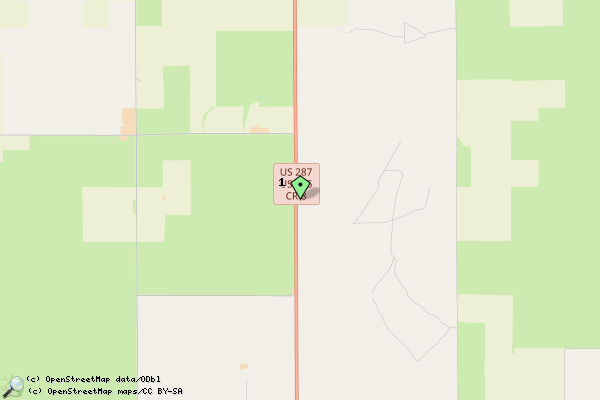
| id | symbol | latitude | longitude | description |
|---|---|---|---|---|
| 1 |  |
37.922263º | -102.611224º | Site Location |
Construction
While many have speculated this site to have been built alongside Cheyenne Mountain, military records show it to have been activated in March of 1956 as “Colorado Springs Comms Facility Annex.” Based on a 1941 route map, AT&T already had a K-carrier long distance cable to Lamar at that time.
Formal DoD records on this site, such as real property cards, have proven elusive. The lack of clarity over the site's formal name is no doubt a factor.
History
Much of this information comes from a mailing list conversation and particularly a very helpful post by Tim Tyler.
It was known as Operating Location Alpha Bravo, later just Operating
Location Alpha & administratively it was an annex of Peterson AFB, about 150
miles away. It was a 24/7 operation with a crew of about 18 people
assigned, mostly radio ops, and then 5 or 6 radio maintenance troops.
Circa 1998, there was still a faded sign up at the main gate which on
which the original wording was:
US AIR FORCE OL A B NORAD ADC TACTICAL RADIO STATION 47 COMMUNICATIONS GP
but then painted atop it in a later era was:
US AIR FORCE OL A NORAD COMBAT OPERATIONS CENTER HF TACTICAL RADIO STATION LAMAR COLORADO
Tim Tyler also quotes the 1985 book Nuclear Battlefields by William Arkin & Richard Fieldhouse:
Lamar AFS: NEACP/SAC airborne command post ground entry point. Terminal
node of buried blast resistant coaxial cable providing communications to
Cheyenne Mountain, 165 miles away, linked to AT&T hardened central office and
and [sic] transcontinental hardened cable.
We know that the “terminal node of the blast resistant coaxial cable” part actually refers to the neighboring AT&T site, and the ground entry point probably does as well (AT&T operated the GEPs on contract). So, this quote is mostly useful to illustrate that there has been some historic confusion between these two adjacent facilities.
The site was clearly abandoned by the late 1990s, and went through a series of private owners before it was purchased by the county for use as an emergency operations training site.