Socorro L-3I Underground
Socorro, or Socorro #2, was a switching main station for the transcontinental L-3I station. It's a relatively large station for the system, as it housed an AUTOVON tandem and served (at least for a time) as an alternate regional NOC and synchronization clock source.
| Built | early 1960s |
|---|---|
| Fate | Mothballed |
operating instructions
Various functions are available as part of the map.
mouse/touch operation
- moving by grabbing the map with a mouse-click you can move the map around
- overview map using the < button in the bottom right of the map you can expand an overview map
- zooming in and out using the + and - buttons in the top left of the map you can obtain more or less detail in the map
- switching themes or maps clicking on the ≡ icon on the right-hand side of the map you can view and select available maps and themes
- retrieving information the map may contain elements that contain more information, by clicking these a popup will show this information
- fullscreen display using the ⛶ button the map can be maximized to fullscreen display, use the ▢ button to return to page display.
keyboard operation
Keyboard operation becomes available after activating the map using the tab key (the map will show a focus indicator ring).
- moving using the arrow keys you can move the map
- overview map using the + button in the bottom right of the map you can expand an overview map
- zooming in and out using the + and - buttons in the top left of the map or by using the + and - keys you can obtain more or less detail in the map
- switching themes or maps clicking on the ≡ icon on the right-hand side of the map you can view and select available maps and themes
- retrieving information the map may contain elements that contain more information, using the i key you can activate a cursor that may be moved using the arrow keys, pressing the enter will execute an information retrieval. press the i or the escape key to return to navigation mode
- fullscreen display using the ⛶ button the map can be maximized to fullscreen display, use the ▢ button to return to page display.
It's possible that some of the functions or buttons describe above have been disabled by the page author or the administrator
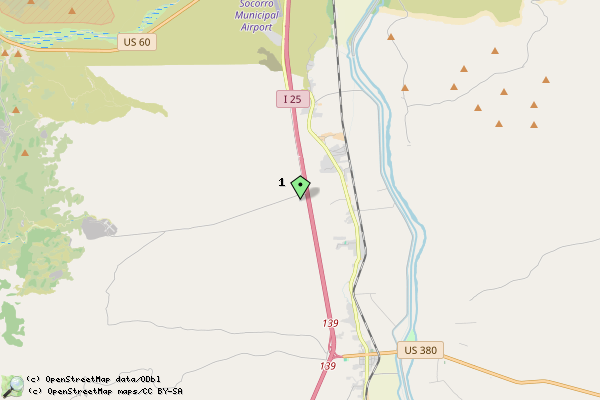
| id | symbol | latitude | longitude | description |
|---|---|---|---|---|
| 1 |  |
33.961835º | -106.890401º | Site Location |
Socorro is no longer in use; while the ROW to the west has been reused for a fiber optic cable, it actually bypasses Socorro entirely on its turn north to Albuquerque. It still receives basic caretaking. Note that some photos here were taken in 2017 prior to the removal of the horns and repainting of the building; the white and blue paint is original. Later photos show it repainted in a dark and rather dull color.
Routes
| Destination | Direction | Carrier |
|---|---|---|
| Quemado L-3I | West | L-3I |
| Vaughn L-3I | East | L-3I |
Background
Effective nuclear deterrence required a fast and reliable communications network that could be used for command and control of nuclear weapons. Further, this communications mechanism needs to be “hardened,” that is, able to survive an enemy attack. In order to develop such a communications network, the government naturally reached out to the country's foremost experts in long-range communications, AT&T.
For AT&T, this request came at the same time as another major advancement in long-range communications: the L-carrier. “Carrier” in the AT&T network was used to refer to an encoding standard used to carry multiple phone conversations (multiplexing), and the L-carrier multiplexed phone conversations onto a coaxial cable, similar to the kind you use for cable television. AT&T, though, always aimed for maximum capacity, and so they both multiplexed phone conversations onto a coaxial cable and bundled multiple coaxial cables into a single large cable suitable for direct burial in the ground. This whole arrangement was called the L-carrier, and generally constituted a multi-core cable (that is, mutliple coaxial cables bundled into one large cable) along with supporting electrical and other power connections that could carry several hundred phone conversations simultaneously. L-carrier was used to build some of the first high-capacity transcontinental telephone trunks. L-carrier went through various generations, numbered L-1, L-2, L-3 etc.
On top of the L-carrier, AT&T built a system called AUTOVON. AUTOVON, or the Automatic Voice Network, was essentially a separate telephone network similar to the civilian one we all use but specifically dedicated to military use (AUTOVON was a precursor to the more modern defense switched network [DSN] and other military telephone systems). AUTOVON needed to be able to survive a potential nuclear attack on the United States, and so AUTOVON calls were carried over a special variant of the L-carrier called L-3I - this name meant L-carrier, third generation, and the “I” was for “Improved.” “Improved,” in this context, meant hardened against attack.
In order to provide all this infrastructure to the military, AT&T had to run L-3I cables across the country and then connect them up to a separate set of telephone switches dedicated to routing AUTOVON calls. For reasons to be discussed later, one of these L-3I cables passed directly through Socorro, and one of these AUTOVON telephone switches was installed in Socorro, or technically in Luis Lopez, in a site along the I-25 frontage road still easily recognized by its large microwave horn antennas on a short tower.
Why Socorro?
Anyone familiar with the area would wonder why Socorro was selected to house both a primary L-3I cable station and an AUTOVON switch - it is not particularly close to any military sites, with Albuquerque, Alamogordo, or Roswell all being more obvious choices as each had an air force base at the time. This mystery is resolved to some extent by thinking about the theory of nuclear survivability: it is best to be very far away from a nuclear target. AUTOVON specifications generally required that AUTOVON switches be located at least 20 miles from potential military targets, and Socorro is ideal in that it is fairly centrally located between multiple military installations but still quite far away from all of them.
Long Lines Microwave
The site located just south of Socorro along I-25, technically called the “Luis Lopez” or “Socorro #2” site depending on which map you refer to (“Socorro #1” refers to a separate microwave site some distance north of Socorro), served multiple roles. First, and in an ongoing civilian capacity, it served as a terminal station in the AT&T Long Lines microwave relay system for long distance phone calls. Long distance phone calls were routed up and down the Rio Grande via point-to-point microwave links.
Socorro #1, north of Socorro, actually relayed directly to San Antonio south of Socorro, but also had a separate route to Socorro #2 which connected calls to the immediate Socorro area. It was something like a railroad siding, handling only local calls in and out of the area and not through traffic. I am having a hard time determining the exact date, but this went into place sometime in the late 1950s, and the microwave antennas still at the site today were installed for this purpose.
Nuclear Hardening
In 1963 or 1964, Socorro was selected as an L-3I Main Station, where electricity was injected on the L-3I cable and calls were multiplexed and demultiplexed on the cable. Socorro was also selected as a regional phase synchronization master for the L-carrier. To meet L-3I hardening standards, this entailed building an underground vault of several thousand square feet with provisions to survive a nuclear strike five miles away. Likely at the same time, Socorro was selected to serve as an AUTOVON switch, which also required hardening.
The several thousand square foot vault would have had about three staff members at any given time, and multiple shifts served the site to provide 24/7 operations coverage. Access was via one of the buildings at ground level that appears to be a garage but has vents around the roofline, this building is of a standard design and can be used to recognize other L-3I underground sites across the country.
Pictured below is the nuclear detonation detector device (NUDET), a small metal capsule on top of a concrete pedestal. Unfortunately not a great photo as the fence prevents getting close. This is a more advanced type of NUDET device that works by detecting sudden bursts of gamma rays electrically, it triggers blast-resistant dampers to immediately close on all air vents both to prevent damage from the overpressure and to keep out radioactive fallout. Many of these NUDET devices also reported back to a Department of Defense system to map nuclear detonations in the event of an attack, it is unclear though if all L-3I vaults were so connected.
To serve as an AUTOVON switch, a 1ESS electronic telephone switch was installed at the vault in Socorro. This switch handled long-distance (tandem) routing of calls between the west coast and east side of the country via the east-west L-3I cable. It likely also served local calls to military installations in the area (Kirtland and Holloman AFBs were certainly on the AUTOVON network) although this has not been easy to confirm.
The 1ESS switch was a large electromechanical switch controlled by a central electronic computer. It was a very sophisticated piece of equipment at the time but would require on-site operators to remain reliable. The Socorro AUTOVON switch was one of not very many in the country and would have served a fairly large area, comprising almost the entirety of New Mexico. In case of a nuclear attack, contingency plans were in place for the Socorro site to take network management orders from a central site in Dranesville, VA. Should the connection to Dranesville be lost, Lamar, Colorado would serve as an alternate central control for the region. In an extreme situation, the Socorro operations staff would be on their own to maintain service to wherever they could still connect to.
I have not been able to locate any photos or floorplans for the Socorro site, or of AUTOVON switch sites in general. However, the 1ESS switch was quite large. It seems to be typical for the vault to contain about 3,000 square feet, most of which was occupied by the 1ESS and L-3I equipment, which were mounted in rows of cramped relay racks.
The L-3I Today
The L-3I cable route has mostly been abandoned, as seen above. However, the segment extending West from Socorro through at least Magdalena appears to have been reused as a route for a fiber optic cable, likely for local telephone and internet service to the towns along highway 60. This can be identified by the substantially newer equipment shacks, including air conditioning, placed on the foundation pads of the L-3I repeaters. Another clear indicator is the right of way warning signs, which have been replaced with signs that explicitly warn of a fiber optic cable.
AT&T formally applied to abandon most of the right of way in 1997. Because large segments of this cable pass through public land, an extensive environmental impact statement was prepared on various plans to retrieve the cable or abandon it in place. Ultimately, most of it was abandoned in place with minimal remediation, although some sections in sensitive wildlife areas have been cleaned up. Larger sections of real estate, such as the L-3I main stations (of which there are several in New Mexico although Socorro is the largest) are generally now in CenturyLink ownership and are still used for fiber optic equipment, storage, and other purposes.


