Oak Hill Microwave Station
Oak Hill is a distinctive microwave site located on Communications Hill in San Jose, California. Many will recognize Oak Hill for the unusual concrete tower, which sits above a partially underground building. Much about the history of Oak Hill is obscure, including the reason for the unusual construction. Functionally, Oak Hill was a microwave station for connectivity to the San Jose CO and likely also exchanged microwave traffic with an L-carrier cable that runs north-south through California.
| Built | 1972 |
|---|---|
| Builder | AT&T |
| Fate | American Tower |
operating instructions
Various functions are available as part of the map.
mouse/touch operation
- moving by grabbing the map with a mouse-click you can move the map around
- overview map using the < button in the bottom right of the map you can expand an overview map
- zooming in and out using the + and - buttons in the top left of the map you can obtain more or less detail in the map
- switching themes or maps clicking on the ≡ icon on the right-hand side of the map you can view and select available maps and themes
- retrieving information the map may contain elements that contain more information, by clicking these a popup will show this information
- fullscreen display using the ⛶ button the map can be maximized to fullscreen display, use the ▢ button to return to page display.
keyboard operation
Keyboard operation becomes available after activating the map using the tab key (the map will show a focus indicator ring).
- moving using the arrow keys you can move the map
- overview map using the + button in the bottom right of the map you can expand an overview map
- zooming in and out using the + and - buttons in the top left of the map or by using the + and - keys you can obtain more or less detail in the map
- switching themes or maps clicking on the ≡ icon on the right-hand side of the map you can view and select available maps and themes
- retrieving information the map may contain elements that contain more information, using the i key you can activate a cursor that may be moved using the arrow keys, pressing the enter will execute an information retrieval. press the i or the escape key to return to navigation mode
- fullscreen display using the ⛶ button the map can be maximized to fullscreen display, use the ▢ button to return to page display.
It's possible that some of the functions or buttons describe above have been disabled by the page author or the administrator
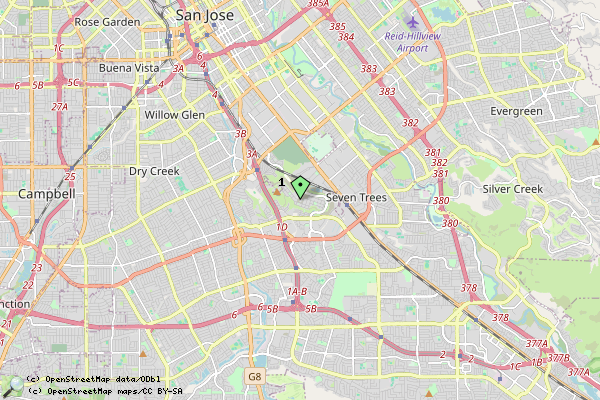
| id | symbol | latitude | longitude | description |
|---|---|---|---|---|
| 1 |  |
37.285095º | -121.8577º | Site Location |
Routes
| Destination | Direction | Carrier |
|---|---|---|
| Hogsback | Southeast | Microwave |
| Sunnyside | Northwest | Microwave |
| East Bay Hills | ??? | Microwave |
| Redwood City | ??? | Microwave |
| Gilroy | South | L-carrier |
| Dunnigan | North | L-carrier |
| San Jose | North | WLEL |
This list is probably incomplete and confusing, the routes seem to have changed over time. A mailing list post from Wayne M H also gives the following. I am not familiar with the maps referenced.
The map I have that seems post-1979 shows Oak Hill with a MW path to
Starr Canyon (aka "Hogsback" and was moved from the San Jose office in
1975), Walpert Ridge, Redwood City (1974 along the path), Loma Prieta
(1975 along the path), and possibly others to the San Jose office.

Another map, or diagram rather, with "AT&T Communications" at the
bottom has Oak Hill with a Lenkurt path to Sunnyvale (Now a PacBell
switch), a DR11 / 609E(?) path to Redwood City (Current AT&T Office),
lightguide to San Jose 02, WLEL(?) to San Jose 02, and TD2 / 609E to
Loma Prieta, and the 11GHz Lenkurt dual path to Starr (For Pacheco
Pass).
History
The history of the Oak Hill site is not well documented, but LinearBob WA6WHT sent an explanation to the ColdWarComms list that goes like this: AT&T originally intended to add floors to its downtown San Jose office (on Almaden Road) and mount microwave antennas there, but expansion of the San Jose Airport lead the FAA to prohibit the added height. Instead, AT&T selected the Communications Hill site, which was already known by that name due to a Santa Clara County emergency communications facility nearby. This became known as “Oak Hill” within AT&T, and the microwave facility served mostly as a “remote” radio site for the San Jose downtown office.
Based on LinearBob's story, construction of Oak Hill would have been sometime in the late 1960s or 1970s. Indeed, historic aerial images bracket it between 1968 and 1980, and a tangential mention in a San Jose planning document puts the date of construction at 1972.
Microwave IF signals were conveyed between San Jose and Oak Hill over 4-5 miles of coaxial cable, allowing most of the mux equipment to stay at San Jose and perhaps explaining the relatively small floor area and power plant at Oak Hill. This was a system called “WLEL” or “Wireline Entrance Link,” used for short-haul carriage of microwave supergroups.
Oak Hill didn't just serve microwave, the 1979 route map appears to depict a north-south L-carrier cable passing through. Other mailing list posts suggest that this cable was rerouted to appear at Oak Hill during the later part of the 1970s, as AT&T continued to relocate more equipment to the remote site. It is not thought that there was ever power feed equipment at Oak Hill, due to its close proximity to the San Jose CO, but Oak Hill may have had equipment to exchange groups or supergroups between the cable and microwave.
Another point of interest about the Oak Hill site is the presence of early encryption equipment, documented by interior photos at Long-Lines.net (see below). Similar equipment appears at some other microwave sites (including, reportedly, Bernal Heights) and is thought to be an artifact of a Cold War program in which AT&T encrypted select microwave links near possible Soviet/Russian intelligence collection centers. The equipment in the Bay Area was presumably in response to the Consulate General of Russia in San Francisco, which included apparent SIGINT equipment on the roof. The “For Future Use” stickers on the encryption equipment (apparently present at other sites as well) calls into question how far the deployment of this encryption system ever got.
Construction
The tower at Oak Hill is an unusual concrete design, unique but not unprecedented considering vaguely similar towers at some CO sites like Queene Anne Hill in Seattle. The reason for the unusual and interesting tower remains unknown. Another oddity of Oak Hill is the building, which was built by cut-and-cover or had soil piled against it later so that it is semi-underground. The roof remains exposed, but the walls are covered by sloped earth. This does not appear to be a hardening measure, especially since the building lacks blast doors or vents.
Both the tower design and semi-underground building may have just been accommodations to local aesthetic objections. Bernal Heights seems to have been similarly part-buried, likely for the same reasons.
When the Oak Hill site was originally built, it was isolated on the hill. The residential development around the tower is a later project.
The underground building leads to an interesting arrangement where microwave feedlines leave the building through an underground gallery that runs directly beneath the tower, where feedlines turn upwards. It's actually quite elegant compared to the hardened microwave sites.
Photos
More Information
- Long-Lines.net (including interior photos)